


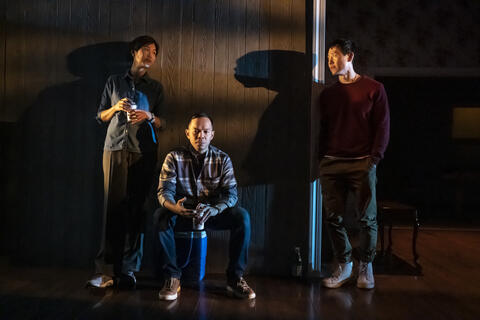
Mia Chung’s play Catch as Catch Can has a curious production history in that it’s had two New York City premieres. While the 2018 production produced by Page73 at the New Ohio Theatre is the world premiere, in 2022, Playwrights Horizons produced the play about the Phelans and Lavecchias, Italian American Rhode Islanders, with an all-Asian American cast. This intertwined production history is befitting a play that bridges generations and double casts its three actors as both adult child and their parent in the same scene to virtuosic effect.
To commemorate the publication of Chung’s play in Theater 56.1, I commissioned a series of conversations with the directors and actors of the two productions. Part of Ken Rus Schmoll and Daniel Aukin’s directors’ conversation appears in the issue as the introduction to Chung’s play, but there were hours (and pages) of rich discussion left. Rather than gathering the casts of each production to speak about their characters, the rehearsal process, their craft, and experiences performing the shows, we chose to pair actors across productions who played the same parent-child characters: Jeff Biehl with Jon Norman Schneider, Jeanine Serralles with Cindy Cheung, Michael Esper with Rob Yang. By tracing counterfactual genealogies between both 2018 and 2022 productions, these conversations form a more capacious and curiouser oral history of Catch as Catch Can.
— Christine Mok, Guest Editor, “Plays for Asian America,” Theater 56.1
In Theater 56.1, directors Ken Rus Schmoll and Daniel Aukin introduce Mia Chung’s Catch as Catch Can in the form of a conversation. Schmoll directed the world premiere of Mia Chung’s Catch as Catch Can in 2018 at the New Ohio Theatre, produced by Page 73 Productions and starring Jeff Biehl, Michael Esper, and Jeanine Serralles. In 2022, Playwrights Horizons produced the second New York production of Catch as Catch Can, directed by Daniel Aukin, starring Cindy Cheung, Jon Norman Schneider, and Rob Yang. The following is an extended cut of Aukin and Schmoll’s transatlantic tête-à-tête, which foregrounds their processes as directors. The following text has been edited for clarity and concision.
DANIEL AUKIN A huge part of the collaboration was working with set designer, Matt Saunders. There’s something weird about the fact that you design the set before the first day of rehearsal. I understand why that’s true, why it’s necessary, but you want to start designing the set on the last day of rehearsals.
We had to get our heads around a lot of play, which is always true, but it was very particular with this one and all these decisions get made long before I got to work with actors in any meaningful way.
KEN RUS SCHMOLL Did you have a guiding idea or question with Matt?
AUKIN My starting approach is usually purely functional. Then, something aesthetic starts to emerge out of the functional solution.
SCHMOLL We are very similar in that regard: I approach design very functionally too. I don’t know how else to approach a play, but, with this play, we had to. We were in the New Ohio [Theatre], which is both large and small. It has those columns that kind of compress it. There are many locations in the play and many different kinds of scenes, so Arnulfo Maldonado and I worked practically from there.
Also, we knew that the set had to function simply as the house. It couldn’t have bells and whistles. It couldn’t do the work of the play. Nothing about the design could point to what was going to happen later in the play, so that the play could happen against it, in relation to it.
AUKIN That makes me think of the act of trying to get out of the way as much as possible already dictates an aesthetic weirdly. But it just comes later. It’s like, oh, I guess that’s what we’re doing. How can we just get out of the way so this can happen?
To not be duplicative in terms of something that the play’s already doing. There’s so much porousness and transformation inside this play. That’s part of the joy of it. And for the set, we weren’t looking to add to that. How can we get out of the way? The simple way to get out of the way is really hard.
***
AUKIN I’m somebody who really struggles with finishing anything. That’s what partly draws me to this thing we do. I’m faced with the deadline of a bunch of strangers, and it’s the only thing that can get me to stop tinkering. I’m misstating: it’s not about tinkering endlessly. But the absoluteness of the stranger deadline is the only thing that can galvanize my priorities.
The knowledge that in x days a stranger is going to be looking at it. I can’t get to everything. They’re coming in five days. They’re coming in four days. And is the best thing tomorrow not to rehearse? To let them have a show without me tinkering? That might be the best thing. Forcing me to have those difficult conversations with myself about what’s the most important, most useful thing to do now.
SCHMOLL There’s a moment when I have to back up and remind myself what I was doing at the beginning. What was I aiming at? Not that that doesn’t change, necessarily, but reconnecting with the original impulse to work on the play. I find directing is constantly about zooming in and working very specifically then backing up and looking at what you’ve done. That constant movement. But, when you’re down to the wire, it’s important to just say: What is the most important thing? Is it telling the story?
AUKIN Yeah, are we telling the story? There is no Platonic ideal, it reinvents itself every night to some degree. A perhaps negative way of thinking about this is that I’m trying to help build something so that on its worst night, it still fundamentally works.
***
AUKIN Whenever I teach workshops or when I’ve taught grad students, one exercise that I’ve done is I write out the play by hand over several weeks— it’s so boring—in a notebook, and then I throw that notebook away. But I keep a second notebook of the things that come up while I’m copying out the play in the first. Useful stuff starts to bubble up if you’re willing to be patient and not push.
It’s not fun exactly, but I’ve never regretted doing it. It tends to provoke something in my intuition or my imagination. It’s happened enough times that something has come up that I think it’s useful.
SCHMOLL That’s so brilliant. It’s like the closest possible read you could do, in a way. A slow, close read of a play, but it’s different from reading. There is something about taking it into your body. It’s almost like performing it or reading it out loud to yourself. But slower. The slowest possible way through a play. You can read a play every day for weeks in preparation. But when you’re writing it out, you can’t assume.
AUKIN Yeah, the thing about writing it out is that it takes off the table the panic of, “Well, what am I gonna do?” “How am I going to do this?” “What’s my point of view?” “Is this gonna fail?” I’m not saying all those things go away, but it turns the volume down a lot. It’s just so neutral – it’s as neutral an act as I can manage.
SCHMOLL I think my version of that is to make lists. I make endless lists of all the various things in the play. Even if they’re not used or if they’re not really important to the play, I’m trying to pull out the components. Like lists of things in the play that are the same, or things that are inverses of each other, which, in this play, is like a constant. Or reading a play once from one character’s perspective and reading it again focusing on another’s. They become ways of looking.
We shared one list with the actors: there are 60 offstage characters. When you read through them, you start to learn something about the world, that these people are important enough to be included in this world. It helps me to think less linearly about the play, the progression of the play.
Daniel Aukin is a New York–based director. Productions include David Adjmi’s Stereophonic and Sam Shepard’s Fool for Love, and many world premieres of new plays. Artistic Director of Soho Rep (1998–2006). Honors include Tony, Obie, Drama Desk, Drama League, and Callaway Awards. He cofounded Physical Plant in Austin, Texas.
Ken Rus Schmoll is a theater director, primarily of new plays. He is an affiliated artist with Clubbed Thumb and cofounder of their directing fellowship. He is the recipient of three Obie Awards and nominations for both the Lucille Lortel Award and the Drama League Award, and was twice a finalist for the Joe A. Callaway Award.