


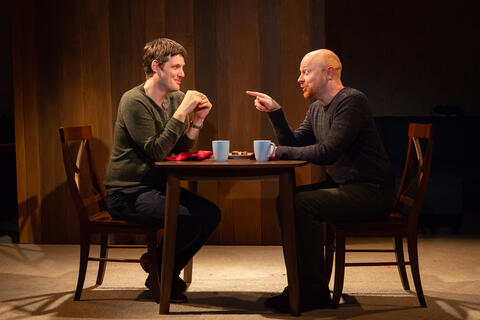
Jeff Biehl played Roberta and her son Robbie Lavecchia in Page73’s premiere production of Mia Chung’s Catch as Catch Can in 2018. Jon Norman Schneider played Roberta and her son Robbie Lavecchia in Playwrights Horizon’s 2022 production of Catch as Catch Can. In July 2025, while Theater 56.1 was underway, the actors held a conversation over Zoom. The following has been edited for clarity and concision.
JEFF BIEHL I re-read the play last night. I didn’t intend to read the whole thing. I meant to skim it, to refresh my memory.
JON NORMAL SCHNEIDER What did you get from re-reading it?
BIEHL So many things! From the beginning, that first scene, I just love these two ladies so much. And they are so racist. Like, just so so so racist. I’d forgotten how many terrible things they say when they’re talking about Cindy, Robbie’s ex, and Tim’s pretend fiancée. The oldest, worst stereotypes you could imagine. That surprised me. But, also, they’re so funny and endearing. And aggressive.
I remember the audition, and it going really well because I liked the characters so much. There’s something about Roberta that felt very close to certain members of my family—minus the overtly extreme racism, thank goodness. I grew up in South Jersey. There’s a similar kind of aggressiveness that love is behind. And certain speech patterns, mannerisms. The way she gets so amped up at the idea of having people over and making meatballs. I swear the dinner scene is exactly like Christmas Eve at my family’s house.
SCHNEIDER When I was thinking about the experience of doing this play, the thing I kept feeling was what a pleasure it was to be in that world. I agree. Those characters, I felt so protective of them, you know? They feel quite well-drawn in this very specific way. Being in that world and playing those characters, the residual feeling in my body was, oh, I miss them!
BIEHL Same here. I was wondering, because our cast was all White people, what was it like for you and your cast to do it—to say and embody those things?
SCHNEIDER It was honestly so fascinating. As Asian American actors, we are never asked to say those things in that context. Even the project of embodying White characters is not something we’re normally asked to do. It felt a bit like we were getting away with something.
The whole play lets you into moments that you’re not really supposed to see, which is why it’s so affecting and brilliant. I know that Mia [Chung] was—and I know I can’t speak for her—curious about what it would do to, and for, the play to cast these parts as Asian American. Curious about what the performance of whiteness looks like with non-White actors and what that can add to the already complex conversation she wants to have in the play.
We didn’t talk a ton about it as a cast. We acknowledged the racist language, but we were playing these characters—and these are the things they were saying, these are the ideas that they had. Speaking for myself, I was like, this is what Roberta thinks. I tried to honor her point of view without commenting.
It was such an interesting prompt. Because the play is so much about identity, and the performance of identity, I thought adding the fact that we were performing these very specific White people who happen to be in a family together was really interesting. Never have I ever come across that before.
***
BIEHL How about that Rhode Island accent?
SCHNEIDER Yeah, the lucky thing for me was that I discovered the Rhode Island dialect for these characters was very similar to what I’d heard growing up in Little Italy in the Bronx. These Italian families have lived there for decades. The rhythms felt so familiar. The sensibility. There were shifts that I had to make in terms of some vowel sounds, but it was so similar to my ear.
***
SCHNEIDER I love Ken [Rus Schmoll] so much, I think he’s a genius, I’m curious how your process was once you started rehearsing, and what it was like to work with him and with Jeanine [Serralles] and Michael [Esper]?
BIEHL They’re all just the best; it was just the best there was. There was immediate trust and real vulnerability. I think that’s the nature of the piece, of playing parents and the kids as adults. I know the three of us were thinking about our own families a lot, our own parents, though it’s not to say that we’re doing impressions of them. Maybe a little bit here and there. I was definitely nervous when my mom came to see the show. Everyone was just so open-hearted and also terrified.
The dinner scene is a theatrical tour de force. I still don’t know how we did it. I remember the insane number of technical details that had to be solved for that scene to work. Michael as Timmy had to untie the Christmas lights, so they had to be handed to him in a ball that he could untie in just the right amount of time to start stringing them up.
SCHNEIDER Daniel [Aukin]—also a genius, by the way—after our second day of rehearsal was like, that dinner party scene is a beast and I don’t know how to do it. And we were like, great because neither do we, and he’s like, what we’re gonna do is touch it at least once every single day. Which spread out the pain. When he said that, I was like, that sounds so hard! But when we came to the end of our time in the rehearsal room, we’d touched that scene so much that, in some ways, it became the easiest scene in the play to do. We had done it so much and we had failed at it so much, we knew every single beat of that scene and what it needed. By the time we were doing runs, we didn’t have to think in the scene. We were just doing it.
***
SCHNEIDER One of the things I admire so much about Mia’s writing is she has such a light touch with information that the audience doesn’t necessarily know they’ll need to know, that then, later, pays off. She is able to sprinkle, Trojan-horse style, bits of information that then become really meaningful. That last scene is so beautiful…
BIEHL Oh, the scene at the end of the play with Robbie and Tim in the hospital? Oh, my God!
SCHNEIDER So gorgeous.
BIEHL Heartbreaking.
SCHNEIDER Heartbreaking.
What the play is able to achieve is unlike anything I’ve ever come across. I feel like when I’m trying to articulate what it is about the play to somebody else, it’s so difficult, because so much of it feels like magic. It feels ineffable and happens in the doing of it.
It would be different if it were a movie. I mean, I don’t know how it could be a movie unless it was a movie that really leaned into all the theatrical conceits.
BIEHL There’s some something about the physical bodies.
SCHNEIDER In space.
BIEHL And the same person playing multiple roles, which is in Mia’s stage directions. Reading it as a play is completely interesting, but seeing it as a production in physical space makes it multi-dimensional in a way that presses all these buttons in my humanity. It works on you in a way that’s almost not conscious.
SCHNEIDER I told my friend that the technology of the play is mysterious, sophisticated, and meticulous. It asks so much of everyone involved: the actors, the director, the designers, and the audience. It asks everybody to meet it.
So many things have to be executed at such a high level of difficulty. When you approach it, the reaching for it is so beautiful. The reaching for it as collaborators. Everybody in that room together, the audience, it feels so electric. That’s what theater can do.
I miss this play.
BIEHL Me, too.
Jeff Biehl: Robbie/Roberta in World Premiere of Catch as Catch Can for Page 73. Broadway: Patriots, Machinal. Upcoming/Recent Off-Broadway: ANON: a tempest at our kitchen table (MCC), The Burning Cauldron of Fiery Fire (Vineyard/Civilians), Waiting for Godot (TFANA), The Unbelieving (Civilians), Merchant of Venice (TFANA), Life Sucks. (Wheelhouse – Nomination, Drama Desk Award for Outstanding Actor in a Play).
Jon Norman Schneider is an actor living in Brooklyn, NY. Most recently, he played the title role in NAATCO’s acclaimed production of Henry VI at The Public Theater. He’s worked at theaters all over the country and abroad, and has appeared in films and TV.