


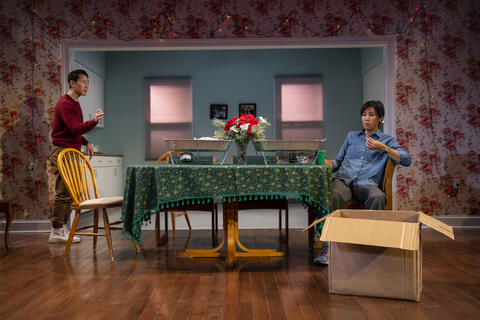
Jeanine Serralles played Lon and his daughter Theresa Lavecchia in Page73’s premiere production of Mia Chung’s Catch as Catch Can in 2018. Cindy Cheung played Lon and his daughter Theresa Lavecchia in Playwrights Horizon’s 2022 production of Catch as Catch Can. In late June 2025, while Theater 56.1 was underway, the actors met over Zoom. The following conversation has been edited for clarity and concision.
CINDY CHEUNG What drew me to Catch Us Catch Can was seeing you do it!
JEANINE SERRALLES Oh, you saw it? Oh, wow.
CHEUNG I’m sure you’ve heard this before, but it was one of the best things I’d ever seen. I thought you were extraordinary.
There was a little part in the back of my head that was like, “Wow, I don’t know if I’ll ever get a chance to play a role like that.”
SERRALLES The fact that it‘s about flawed people who are family, who are not perfect by any stretch—the “Don’t like these people too much!” quality that Mia [Chung] put in it. That’s what drew me. And, of course, the switching of the characters.
CHEUNG It’s an actor dream. It’s not done with hats.
SERRALLES Just the body.
***
SERRALLES So much has stayed with me. I loved the fun of flipping back and forth between Lon and Daniela, I really enjoyed that so much. The humanity of it—and that the actor is trusted to tell the story.
CHEUNG We were doing that Christmas party scene and flipping back and forth between characters. At one point, I was carrying two six-packs of beer across the stage, and, from the house, Daniel [Aukin] says, “Slow down, Lon! Slow down! Too fast, Lon!” In that moment, I understood something about that guy, and it gave me permission to take time with him.
I really appreciated working with Daniel. He’s actor-first, truly collaborative, and exploratory. He might have an idea about something but wants to know your idea and is willing to give up his if you prefer another. Like the scene where language breaks down.
Your version of that is so burned in my brain, Jeanine. There’s a moment towards the end of the play where Daniela is trying to tell Roberta about something traumatic, and she loses her ability to say words. The lines are very specifically-scripted syllables. It’s the genius of Mia that, as language is breaking down, the play itself breaks down. The scene starts to fracture until the speech is just sounds. Your performance of it was so affecting to me.
When we were exploring in rehearsal, I was just poking around at all the different ways to go about it. For a while, it was really messy, snotty, super emotional. We did a run-through, and Adam Greenfield [artistic director of Playwrights Horizons] was like, “Whoa, your aria at the end….” I remember being so embarrassed because the Tim character has this really emotional breakdown at the end, and I remember thinking that I don’t know that the play is supposed to have two of those.
I really appreciated the opportunity to explore that as far as I wanted to. Then we tried a different way where it was almost blank, you know? And Daniel said, so gently, “My preference is the smaller version, but you seem to really want the big version. I’m willing to go there with you if you wanna keep doing it.” And I was like, no no no. This was in rehearsal, and I was horrified of being indulgent. In retrospect, I was exploring, and he was genuinely giving me the space for that.
SERRALLES That’s so interesting because you saw a production of it, but you have to erase the memory of that production in order to successfully build your own. Three different people, different directors, different days, a different time.
CHEUNG And a production that’s hard to erase because it was really impactful. Do you know what I mean? What you all did was so beautiful.
SERRALLES You just reminded me: the aria, that section where the language breaks down. Mia deserves a lot of credit. We, all three of us, pushed her on the play, on things we felt were not working.
She stuck to her guns and she didn’t take offense. I really admired her for that because I was like, “I don’t know if this is working. I’m trying it five different ways. It’s not working. This isn’t working blah blah blah.” And she’s like, “It’s working. It works.” But it never got tense. We were just going through it! She knew we loved her and the play so much. And we ended up with something that did work, though I think I manipulated the language in a way that wasn’t what Mia intended. But happily, it all worked out. Miracle of theater!
***
CHEUNG Lon actually came more easily because he was further from me. I’ve never been asked to play an older White man from Rhode Island before. It was character work. But with Daniela, she wasn’t as drastically different from me. Maybe I don’t have to do that much—which, of course, as an actor, meant I was always worrying: am I doing enough? Whereas Lon, it felt clearer that I was “doing” something, speaking with a different cadence, moving my body through space differently.
SERRALLES I really loved the accent. It’s Rhode Island, right? Which I was told is a mix between Boston and Long Island. I thought that was really fun and challenging. And it’s only Lon who has the strong accent, so that was a way of getting into Lon.
CHEUNG I remember the opening scene. The two women are having a conversation while Lon is just sitting in the other room. And I’m like, so what am I doing? What’s the reason for my being here? And then I had the thought, oh, I’m a 65-year-old White guy. I don’t have to fucking do anything. I can just sit here and take space for as long as I want. I don’t owe anybody anything.
There is a lesson in that. I wonder why I, Cindy, don’t allow myself to experience that more, you know? Just sit there and not have to do anything particular. I appreciated getting to step into Lon’s shoes and discovering something about myself. Maybe I don’t have to be a 65-year-old White guy to claim my right to exist in this world. Thanks, Lon, for showing me that.
SERRALLES I think what was surprising was how easy it was to flip back and forth. How easy it was to switch. I’m sure a lot of people who saw the show said to you, “How’d you do that?” And I was like, “Well, you know actually, once you got it, it’s fun and easy.” But you have to drill it into the ground.
CHEUNG For me, it was finding again, oh, I don’t have to do so much. A lot is in the play, in the writing, the relationships. It was a lot of letting go of certain things. Then you learn that it works, that it reads—so trust that. Those subtle things inside were being received.
I remember doing Scene 6, realizing, “Oh my gosh, Jon Norman [Schneider], I’m your daughter, your husband, your sister—was I ever his mother? No—and your dad!” Four things back and forth, back and forth. And it was so easy. Also, because it’s Jon Norman, I was never like, who are we now? Right away I knew: you’re my mom; now I’m your dad. That speaks to the brilliance of the writing. That it’s so clear. There’s not a wasted syllable. It’s so economical. The writing is mostly like everyday speech and impactful.
Cindy Cheung: Recent theater: Meat Suit (Second Stage), Laowang (Primary Stages), Bus Stop (NAATCO/Transport Group/CSC), The Antiquities (Playwrights Horizons/Vineyard/Goodman). Recent TV: American Classic, Dying for Sex, The Sinner (S4). MFA from A.C.T. She lives in Brooklyn with her husband, novelist Ed Lin, and their son.
Jeanine Serralles has appeared on stage at MTC, Lincoln Center, The Atlantic, BAM, The Vineyard, Williamstown, The Goodman, Red Bull, Playwrights Horizons, New York Theater Workshop, among others, earning multiple nominations for the Drama Desk Award, Drama League Award, and the Lucille Lortel Award for her work. M.F.A. Yale School of Drama.