


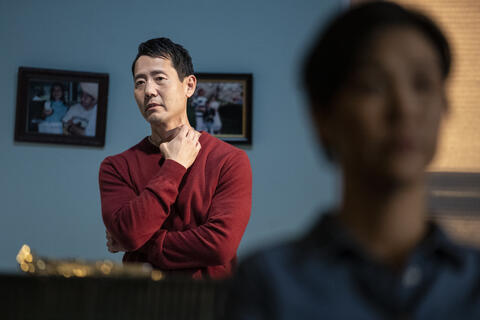
Michael Esper played Theresa and her son Tim Phelan in Page73’s premiere production of Mia Chung’s Catch as Catch Can in 2018. Rob Yang played Theresa and her son Tim Phelan in Playwrights Horizon’s 2022 production of Catch as Catch Can. In 2025, while Theater 56.1 was underway, the actors held two wide-ranging conversations, first in-person in NYC in June, and then over Zoom in September. The following has been edited for clarity and concision.
MICHAEL ESPER I feel like one thing we had in common was a relationship to loss.
ROB YANG Yeah, the loss of parents. The loss of a sense of home, that was what I brought to it. I lost my mom in 2017, and then 2018, I lost my dad. We did the play in 2022, and what I found was that it’s not that much time.
I did not have any perspective. I felt like I had to have my shit together, but I was a mess. It was a mess for a long time. I didn’t want to use it as an excuse for not showing up. In reality, there was a part of my nervous system that shut down. It’s close to eight years now, which is a long time, but still…
ESPER It’s still nothing really.
YANG You mentioned you had a similar…
ESPER My father didn’t pass away until the play was over, but he was suffering, dementia and cancer. He was battling Lewy Body Dementia and was deteriorating at that point. This was the last play I did while he was alive.
I was having an extremely difficult time with how to articulate or express or connect around the moment I felt I was having with him, with my family, with myself, and the world. I had this extraordinary feeling of crisis, and no real way to talk about it.
It’s such an ordinary experience: losing a parent or a parent deteriorating from age. It’s so common. Yet I still find it, and found it, difficult. To connect. I couldn’t get to the heart of myself. Even in my thinking, there was an emergency, some kind of very ordinary emergency.
Though the details of Mia [Chung]’s play are different, there was so much I was thinking about: losing my dad, watching what happened, and the fracturing of identity.
It came at the perfect time. Something felt articulated in the ask of the play that was relevant. The language in the play, both technically and literally, helped me finally understand what I was going through.
YANG I often find that material comes along that perfectly aligns with what you have to work out.
ESPER I think that’s true. I’m always looking for a problem to work out in a play. (Not therapeutically.) What’s the question that’s alive in the play that you can connect to when you’re in performance? What’s the question that’s alive in the material, and how is it related to me? You find something that speaks to what you’re going through—or, you’re just doing a job.
YANG Things that have to do with home and family, mother, father, siblings—they resonate with me. Also, when we were doing it, I felt like I should quit acting.
ESPER [laughter] Why? Because of…? Why?
YANG Because: I don’t think I can do this.
ESPER Meaning I don’t think I can go through this? Or I don’t think I can do this?
YANG Meaning whatever limit of ability I have… I have a limit. It’s unfortunate, I thought it would be more, but this is it. It’s revealing the ceiling.
ESPER I also felt that, that I needed someone to put me away, don’t let me do this anymore. The ask of the play is so huge. Some of the scenes, like Scene 8, I felt technically so stretched to capacity just to try and do them. Where I felt what we were doing was insane. I felt more forgiving in a certain way—because I was like, this is fucking wild.
The scene that made me tear my hair out every night was the scene in the car where the breakdown starts.
YANG It’s interesting because it is so technically demanding on a performer, but, at the same time, to do it you have to let go, be lost in it. It’s constructed in a way that you can’t hold on to any railings. Once you start, you’re off. When you try to grab things, that’s when you lose the thread. I remember thinking I really hope I find the scene in Scene 8, but I can’t think about that right now because I have this thing, then this thing. There are no breaks. I remember being in that car scene and thinking, I can’t even think about the thing that makes me want to quit acting every time. I didn’t feel like, oh, I got this. I never felt that with any of the scenes. That’s when I remember being so grateful to have my partners on stage.
***
ESPER As technically demanding as the play is, the wildest asks of the play are from an acting standpoint. It’s not a play that’s about virtuosity or about a trick for its own sake, it’s real exploration and expression. Trying to uncover something and get at something. It’s asking questions. They’re not just technical turns for their own sake.
The play has all these technical demands, but it doesn’t let you do that much because it pulls you so far out there with these people. There were times I did not know what the fuck was going on. And Jeff [Biehl] and Jeanine [Serralles]—I would look at them with wild—I can see Jeff’s eyes right now! I don’t know that I ever felt so saved or amazed as I did by them. Feeling the way I felt about them as performers and people allowed me to get as lost as I wanted to. Because I knew that they were there for me in this astonishing way.
***
YANG I miss that whole experience. I still carry it with me because it was so incredible working with Daniel [Aukin] and Mia. It felt like I was artist-to-artist, going into the unknown with Daniel and Mia. I felt so supported to let go of everything. Daniel likes to see what doesn’t work, and if something works, he doesn’t highlight it because he doesn’t want to call it anything, because then you destroy the thing. I learned so much from him. It takes an incredibly secure person to work that way. It was taking yourself out of it. What serves the play. And what serves the experience out there.
ESPER One thing that I really loved about the way Ken [Rus Schmoll] and Mia worked with me is they let me really fight it out with them. Not that we had some wildly combative scene or anything. It really wasn’t. They were amazing. They really let me slug it out about how I felt things should be or shouldn’t be.
It must have been a very confusing experience working with me on it because I felt, on the one hand, so lost about how to do things, and then so sure, in a sense, about what those things meant. I remember in that last scene, for example, I had a very particular idea about the place that Tim was in with some of his behaviors because I was lifting a lot of that directly from my dad and some of my dad’s behaviors, some of his aphasia, the way his condition affected him. I felt very tied to it; I just wanted to keep that very close. There was a lot of back and forth. I loved the way they were in the ring with me about it. I felt really honored and supported and allowed to be messy and wrong—really sure and wrong—and also reassured by them about my connection to the piece.
Michael Esper Broadway: The Balusters, Appropriate, The Last Ship, American Idiot, The Lyons. West End: The Glass Menagerie. Off-Broadway: Lazarus, The Intelligent Homosexual’s Guide to Capitalism and Socialism with a Key to the Scriptures, Catch as Catch Can, Assistance, The Four of Us. Tv includes Fallout, Devil in Disguise, the Outsider, Nurse Jackie, Trust. Film: Pavements, Frances Ha, The Creator, Ben is Back, Resurrection.
Rob Yang is an actor and writer, based in LA (for now). He’s appeared Off-Broadway, regionally, and in many dingy, unseen Off-Off Broadway productions. Film and tv credits include She Rides Shotgun, The Menu, Succession, Furious and upcoming A Place in Hell. Rob has no awards or special accolades but holds a degree in finance.